Does Each Cigarette Take 11 to 20 Minutes Off Your Life? The BMJ & UCL Research Explained
The famous British Medical Journal (BMJ) study calculated 11 minutes of life lost per cigarette, while updated University College London (UCL) research estimates 20 minutes. Here is how the math works—and how much life you win back when you quit.
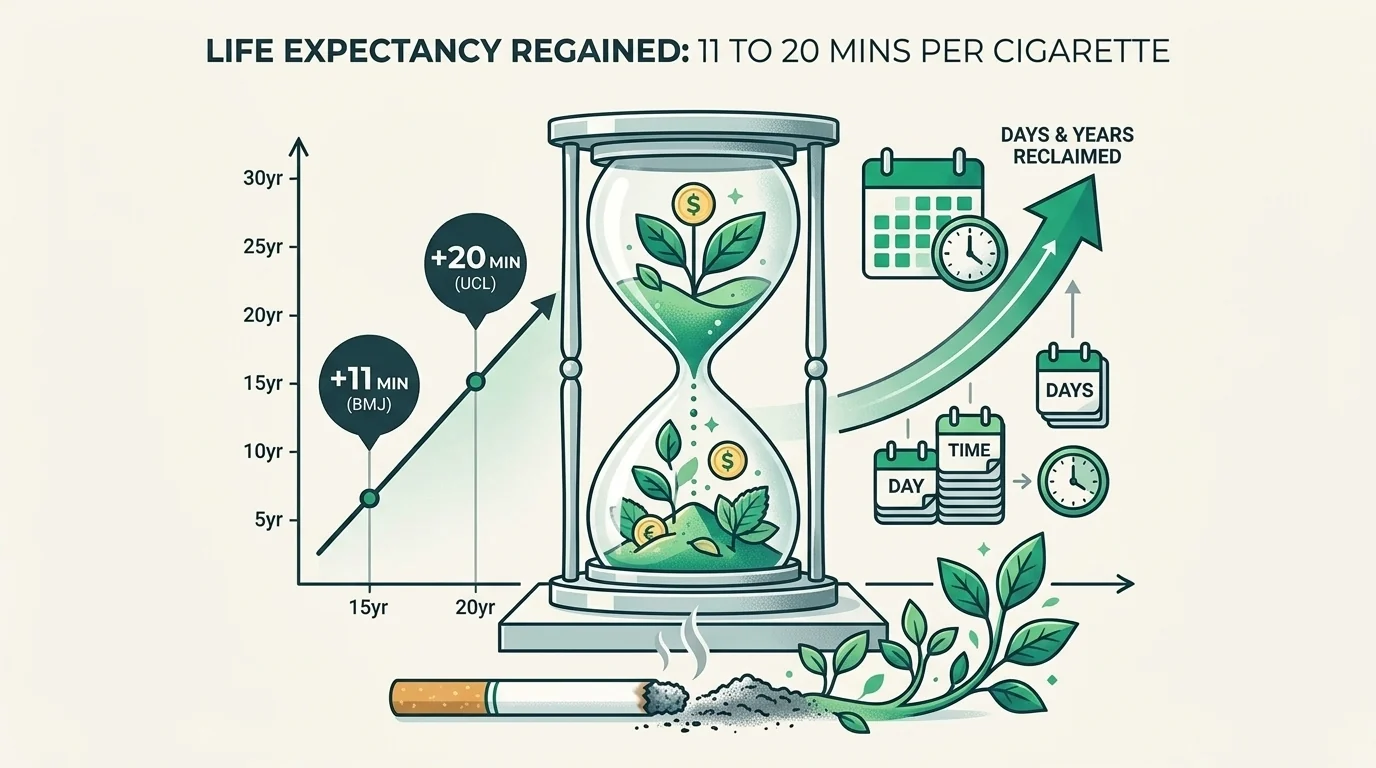
When you look at a single cigarette, the long-term health consequences feel decades away. Epidemiologists at the University of Bristol and University College London solved this psychological distance by translating 50-year population mortality curves into a single tangible unit: how many minutes of life expectancy a single cigarette costs—and how much time every smoke-free day wins back.
The Classic BMJ Study: 11 Minutes Per Cigarette
In 2000, Dr. Mary Shaw and colleagues published their famous analysis in the British Medical Journal (BMJ). Using mortality data showing a 6.5-year average life expectancy gap between male smokers and non-smokers, and dividing by an average lifetime consumption of 311,688 cigarettes (roughly 17 cigarettes per day from age 17 to 71), they arrived at 11 minutes of life lost per cigarette—or roughly 3 hours and 40 minutes per pack of 20.
The Updated UCL Study: Why the Estimate Rose to 20 Minutes
Why did researchers at University College London (UCL) later revise the estimate upward to 20 minutes per cigarette (~17 minutes for men and ~22 minutes for women)? Two reasons:
- Complete 50-Year Cohort Follow-Up: When the original British Doctors Study (Doll et al.) and the Million Women Study (Pirie et al., The Lancet) completed full lifelong follow-up, the true mortality gap between lifelong smokers and never-smokers proved to be 10 to 11 years rather than 6.5 years.
- Fewer Cigarettes Per Day, Similar Toxic Exposure: Modern smokers who smoke fewer cigarettes per day often inhale more deeply and hold smoke longer (compensatory smoking), meaning each individual cigarette carries a higher proportional longevity cost.
Years of Life Gained by Age When You Quit (30, 40, 50, 60)
The most encouraging finding of the 50-year British Doctors Study is how rapidly the mortality curve bends back toward normal after you stop:
| Age When You Quit Smoking | Excess Mortality Risk Avoided | Average Years of Life Reclaimed |
|---|---|---|
| Quit Around Age 30 | >97% of excess risk avoided | +10 Years (Virtually identical to never-smokers) |
| Quit Around Age 40 | ~90% of excess risk avoided | +9 Years of healthy life expectancy |
| Quit Around Age 50 | ~60% of excess risk avoided | +6 Years of life expectancy |
| Quit Around Age 60 | ~33% of excess risk avoided | +3 Years of life expectancy |
To check your cumulative exposure so far, use our Smoking Pack-Years Calculator, or calculate your exact hours and days reclaimed below.
Frequently Asked Questions
How did scientists calculate 11 to 20 minutes per cigarette?
Epidemiologists divided the average total years of life lost by lifelong continuing smokers (6.5 years in the original 2000 BMJ data; ~10 to 11 years in updated 50-year follow-ups of the British Doctors Study and Million Women Study) by the average total number of cigarettes smoked over a lifetime.
Does smoking take time off the end of your life or your healthy middle years?
UCL researchers emphasized that smoking does not merely trim unhealthy years at the very end of old age—it primarily erodes healthy, disability-free middle years by accelerating cardiovascular aging, COPD, and metabolic disease.
How many years of life do you gain back if you quit at age 30, 40, or 50?
According to the 50-year British Doctors Study (Doll et al., BMJ), quitting at age 30 gains back ~10 years of life expectancy (matching non-smokers); quitting at age 40 gains back ~9 years; quitting at age 50 gains back ~6 years; and quitting at age 60 gains back ~3 years.
Clinical References & Primary Sources
- Time for a smoke? One cigarette reduces your life by 11 minutes — BMJ (British Medical Journal), Shaw et al. 2000;320:53
- Mortality in relation to smoking: 50 years’ observations on male British doctors — BMJ (British Medical Journal), Doll et al. 2004;328:1519
- The 21st century hazards of smoking and benefits of stopping: a prospective study of one million women in the UK — The Lancet, Pirie et al. 2013;381(9861):133-141
Tarun builds QuitSmoke Pro and researches nicotine pharmacokinetics, respiratory recovery, and behavioral cessation tools. Every guide is cross-checked against primary literature (BMJ & UCL Epidemiological Literature — British Doctors Study & Million Women Study Cohort Data). Read our editorial methodology →
Important Health Notice: The content, timeline milestones, and clinical data presented on this website and in QuitSmoke Pro are published strictly for educational, motivational, and informational purposes. They do not constitute clinical medical advice, formal diagnosis, or professional treatment. Always consult a qualified physician or healthcare professional before making any medical decisions or if you have pre-existing cardiovascular or respiratory conditions. Review our Clinical Methodology & Primary Sources →
Start Your Healing Timeline Today
QuitSmoke Pro is designed for lasting recovery with live WHO health milestone counters, savings tracking, and an instant craving coach.