Smoking Pack-Years Calculator: Formula & Lung Screening Check
Physicians and pulmonologists use pack-years to quantify lifetime tobacco smoke exposure and determine eligibility for preventive low-dose CT lung screening. Calculate your exact score below.
🔗 Embed or Cite This Free Calculator on Your Clinic, University, or Health Site
Health educators, journalists, and wellness writers are free to embed this calculator with attribution using the HTML snippet below:
<div style="max-width:860px;margin:1.5rem auto;border:1px solid #d1fae5;border-radius:12px;overflow:hidden;"><iframe src="https://quitsmoke.fyi/tools/pack-years-calculator" width="100%" height="720" style="border:0;" loading="lazy" title="Smoking Pack-Years Calculator"></iframe><p style="margin:0;padding:8px 14px;font-size:12px;background:#f8fafc;color:#475569;text-align:right;">Interactive tool by <a href="https://quitsmoke.fyi/tools/pack-years-calculator" target="_blank" rel="noopener">QuitSmoke Pro (Smoking Pack-Years Calculator)</a></p></div>
The Clinical Pack-Year Formula
One pack-year is defined as smoking an average of 20 cigarettes (1 standard pack) per day for 1 year:
Because cumulative exposure drives risk, two people with different daily habits can share the exact same pack-year number:
- 10 cigarettes/day (0.5 pack) for 20 years = 10 pack-years
- 20 cigarettes/day (1 pack) for 10 years = 10 pack-years
- 40 cigarettes/day (2 packs) for 5 years = 10 pack-years
Why Freezing Your Pack-Years Today Matters
Landmark epidemiological research (including the British Doctors Study and Million Women Study) proves that stopping smoking at any age halts further pack-year accumulation and allows bronchial and cardiovascular repair to begin immediately. Explore our WHO Health Recovery Timeline to see how your lungs and heart heal after your final cigarette, or calculate your future wealth with the Quit Smoking Savings Calculator.
Related Clinical Guides
Frequently Asked Questions
How do you calculate smoking pack-years?
Divide the average number of cigarettes smoked per day by 20 (the number of cigarettes in a standard pack), then multiply by the number of years smoked. For example, smoking 10 cigarettes (0.5 packs) a day for 20 years equals 10 pack-years. Smoking 20 cigarettes (1 pack) a day for 20 years equals 20 pack-years.
What is a high pack-year smoking history?
In pulmonary medicine, 20 or more pack-years is classified as high cumulative tobacco exposure. The US Preventive Services Task Force (USPSTF) recommends annual low-dose computed tomography (LDCT) lung cancer screening for adults aged 50 to 80 who have a 20 pack-year or greater smoking history and currently smoke or have quit within the past 15 years.
Does my pack-year score go down after I quit smoking?
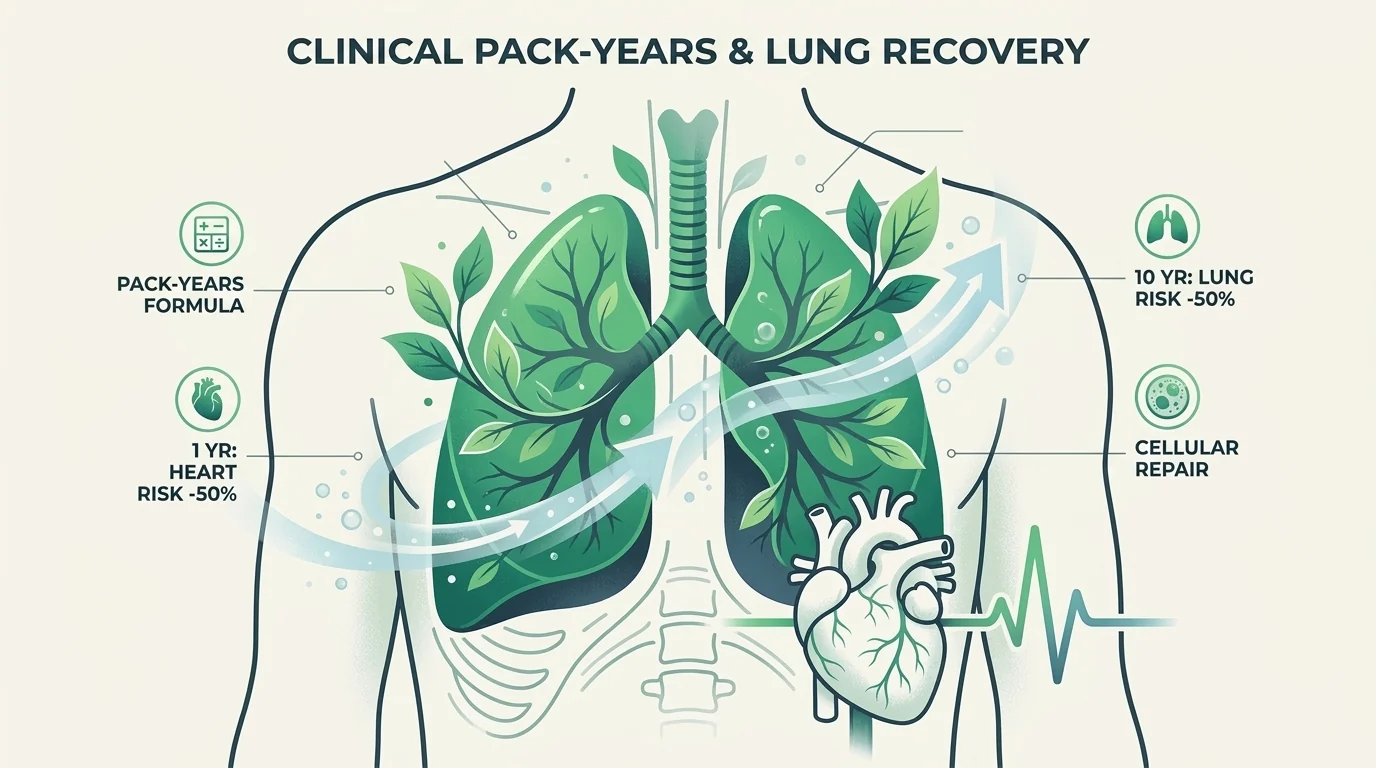
Your cumulative pack-year number stays fixed as a record of past exposure, but your biological disease risk drops dramatically after you quit. Within 1 year of quitting, excess coronary heart disease risk falls by 50%. Within 10 years, lung cancer mortality risk drops by roughly half compared to someone who continues smoking.
How do I calculate pack-years if my smoking amount changed over time?
Calculate each period separately and add them together. For example, 5 years at half a pack a day (2.5 pack-years) plus 10 years at one pack a day (10 pack-years) equals 12.5 total pack-years.
Important Health Notice: The content, timeline milestones, and clinical data presented on this website and in QuitSmoke Pro are published strictly for educational, motivational, and informational purposes. They do not constitute clinical medical advice, formal diagnosis, or professional treatment. Always consult a qualified physician or healthcare professional before making any medical decisions or if you have pre-existing cardiovascular or respiratory conditions. Review our Clinical Methodology & Primary Sources →
Stop Adding to Your Pack-Years Today
Download QuitSmoke Pro to track your biological lung recovery, money saved, and beat cravings in 180 seconds.